
Organic Free-Range Chickens
& Why the ‘Organic’ Makes All the Difference
‘If I had to have only one animal on the farm, my animal of choice would be a chicken.’
George grew up collecting eggs from the hens at Sandy Lane Farm. In fact, one of his first weekend jobs as a child was sorting and packing them into boxes. They have always been a part of the farm, but recently, George has doubled the flock to 400 laying birds: ‘We couldn’t keep up with demand—we simply never had enough eggs!’
He now has two separate flocks in moveable hen houses just next to the market garden: ‘Moving the houses around is extremely important, taking them to fresh grazing and new range. It’s also easier to collect their droppings for composting and generally keeps the flock healthier than if their home was stationary.’
The houses are extremely spacious, with half of the floor covered in scratching straw, plenty of ventilation, good insulation, perches to roost, and quiet nest boxes. As George explains: ‘We have 200 birds in this hen house, which is the maximum allowed according to Soil Association organic regulations. If the birds were free range, you’d be allowed to fit 500 in here—which seems an awful lot.’
If the inside is roomy, the pasture the chickens graze is positively vast. Organic standards stipulate that each hen must have a minimum of 10 square metres of outside space (compared to just 4 square metres for a free-range bird). George’s hens have even more than that and continuous access to it throughout the day. ‘The closer the hens are to a natural environment, the closer you get to their natural behaviours, which is what we want to encourage.’
These natural behaviours are key. Without space and room to explore, chickens get frustrated and (believe it or not) really bored. When this happens, like any animal in close quarters, they form cliques and gangs. ‘You can tell if a chicken is happy by looking at their feathers. If there is feather loss, that’s the sign of a situation that’s not quite right and the birds have been turning on one another. Our birds all have no feather loss—they’re very calm, content chickens.’
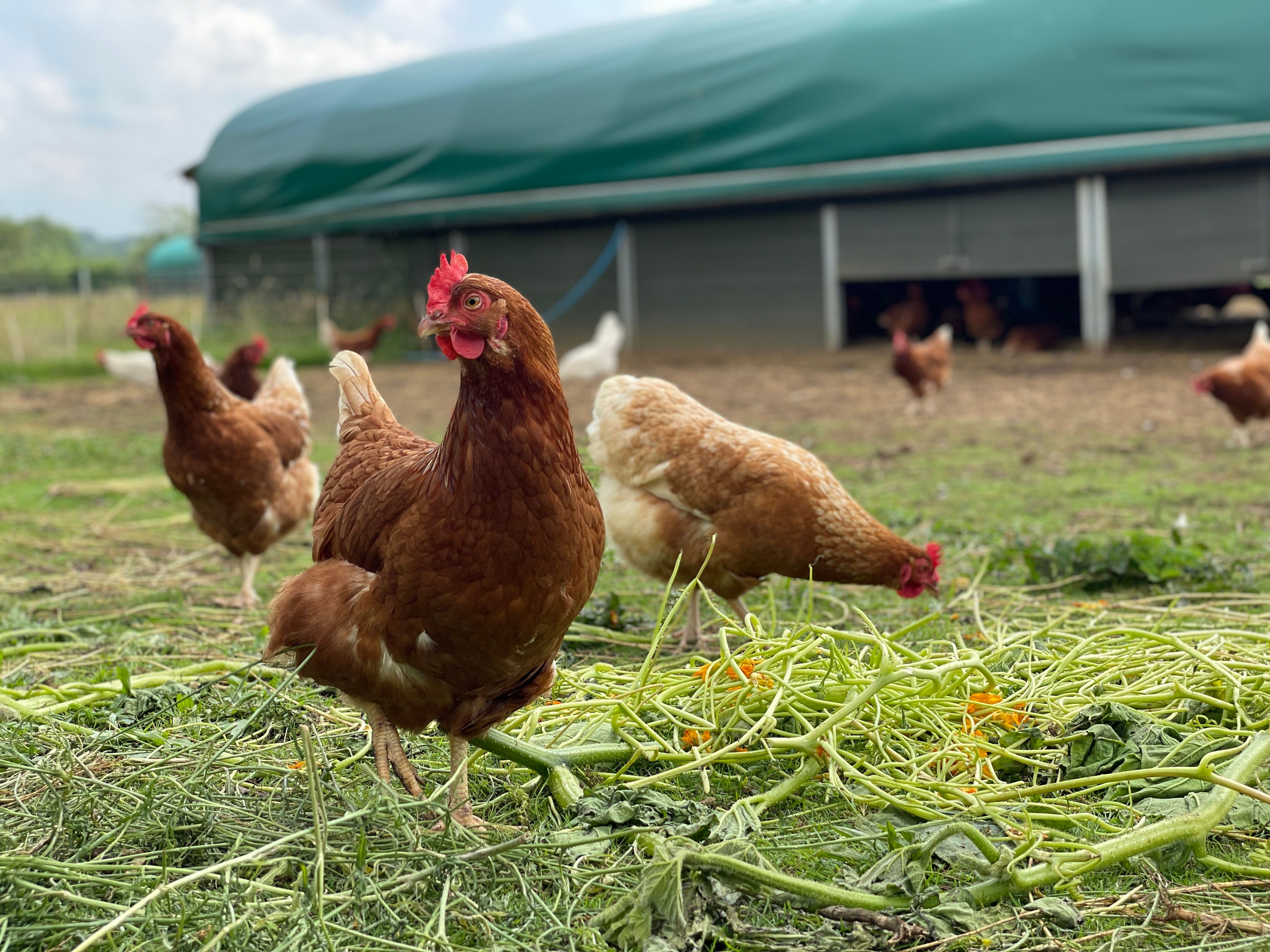
As George is keen to point out, these organic regulations are not there to ‘humanise’ the birds. On the contrary, they are there to encourage them to ‘be more chicken’ and behave as they would in the wild. ‘Everything about the organic regulations is designed to give the chickens space, time, escape routes, and plenty of feeding and drinking opportunities—to make them feel safe, with lots of room to “hang out” and express their natural behaviours.’
While we can all agree from a compassionate point of view that this effort is completely worth it, does it really make a difference to the eggs? George certainly thinks so. ‘When we had to keep the chickens inside due to the avian flu outbreak earlier in the year, the laying rate dropped, the shells became weaker, and the yolks lost some of their deep colour. You could see and taste the difference. Giving them space to roam makes a real impact.’
The eggs George’s chickens produce are particularly flavourful because a portion of their diet is naturally derived—from the seeds, grasses, and bugs they find in the organic soil. They are also rather lucky to be situated right next to the market garden, which means any leftover veg, flowering herbs, and slightly woody agretti comes their way. The team even built a little bridge over the ditch between the polytunnels and the hen’s pasture to make it even easier to toss them treats. The chickens always run over en masse when you approach with an armful of veg—although, as George points out, that’s as much to do with the excitement as the taste: ‘Yes, they enjoy the veg, but it’s the interest as much as anything—something new to explore.’
Chickens tend to slow down their egg laying after a year. When they reach around two years old and produce an egg every other day, George re-homes them: ‘They can go on laying for years, just less frequently. At that point, we give them away. We also have a few long-term residents left in our “chicken retirement home,” who will see out their days under the apple trees. Even they occasionally lay the odd egg here and there!’
All eggs are not created equal, and the conditions in which laying hens are kept can vary hugely. However, if the eggs are organic and follow Soil Association regulations, you can be sure the chickens have space to roam and live life as naturally as possible. And at Sandy Lane, the hens are not just an essential part of the farm—they are truly valued. So, when you choose organic eggs, you’re not just getting a better egg—you’re supporting farming that puts animal welfare first.



© 2026 - Sandy Lane Farm
Powered by
