
Cooking Time
20 minutes
Season
Dietary
Fermented Winter Cabbage
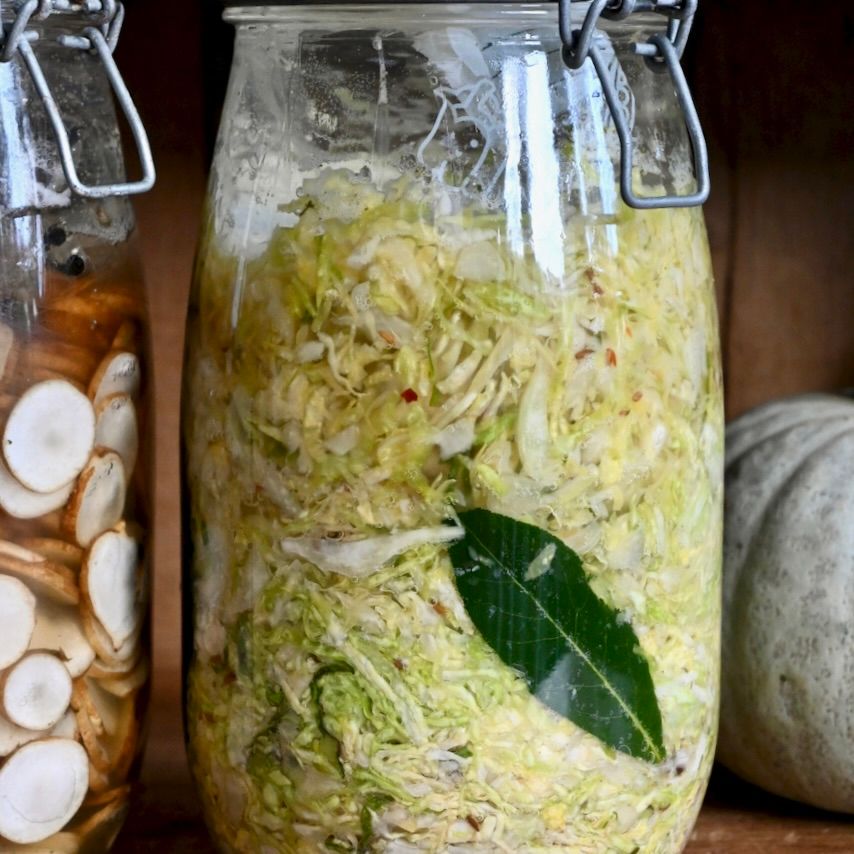
Sauerkraut
This season has apparently been the time of the cabbage? At least that’s what I’m hearing on social chatter, but who knows. January always brings a cabbage or two and more often than not more than we know what to do with. The hungry gap is right around the corner and having a few delicious jars of something in the store cupboard helps to grease the dinner time wheels.
Sauerkraut is conventionally made with a cabbage with high water content, generically referred to as a white cabbage. This is the easy option but lacks seasonal flavour and personality. January king and tundra cabbages are having their moment and are delicious alternatives.
Both winter varieties have a similar profile but with depth and a fleck of purple green for added drama. Simple seasonings such as mustard seeds and caraway are more than enough, but they will take a heavy spicing if your heart so desires.
Makes however much it makes
Preparation time: 20 minutes
Cooking time: 3 – 7 days or beyond
Ingredients:
Cabbages, and a few more cabbages
Salt
Water
Aromatics such as bay leaves
Spices such as caraway and mustard seeds
1.Begin by trimming the cabbages and giving the outer leaves a wash. These are tough but will soften during the ferment bringing a welcome contrast to the otherwise uniform texture of the finished ferment.
2. Shred these outer leaves as finely as you can and put in a large bowl.
3. Finely shred, grate or chop the remaining cabbage, including the stem, and add to the bowl.
4. Weigh the contents and multiply by 0.02 to give you 2% of the weight. What ever this figure is weigh it out in salt and add to the cabbage.
5. Add the spices, using around ½ tsp per kilo as a benchmark, and massage the ingredients together. Get your hands in and really scrunch and squeeze the ingredients together until your hands become quite damp.
6. Add any aromatics to sterilised preserve jars and pack tightly with the cabbage. Pack down as best you can, seal the jar/s and leave overnight in a warm spot.
7. The next day there should be a decent amount of liquid in the jar, at least enough to mean the cabbage is all wet and not exposed to the air. Half fill a sandwich bag with water, or use a fancy fermenting weight, and squish it down into the jar to exclude all the air and keep the vegetables submerged.
8. Leave in a consistent warm environment away from direct sunlight for at least 3 days, making sure to burp (open and close again) daily. As the days go by the smell will intensify as will the flavour. Taste as the days progress and when the flavour is to your liking simply stop the ferment by storing in the fridge. This will then keep for quite a while, around 3 months.
9. Alternatively leave to full ferment and store in a cupboard away from heat or light. This will keep for quite a while but will take proper care to prevent from spoiling. Once open store in the fridge.
Chef Notes:
1. If white fine powder in a thin film develops on the surface, this is most likely yeast and will not be harmful, but the golden rule is if in doubt chuck it out.
2. Any black mould or patches of random colour that develop means the ferment has spoiled and discard.





© 2026 - Sandy Lane Farm
Powered by
